

If SaaS was built to manage tasks, KaaS is built to manage thinking. In a world of vibe coding, the vibe may build the UI, but KaaS builds the brain behind it.
The important shift is not that software disappears. It is that the center of gravity moves. The old SaaS stack of UI, business logic, database, integrations still exists, but it starts to feel thinner when the real value is in how a system retrieves, interprets, and applies knowledge.
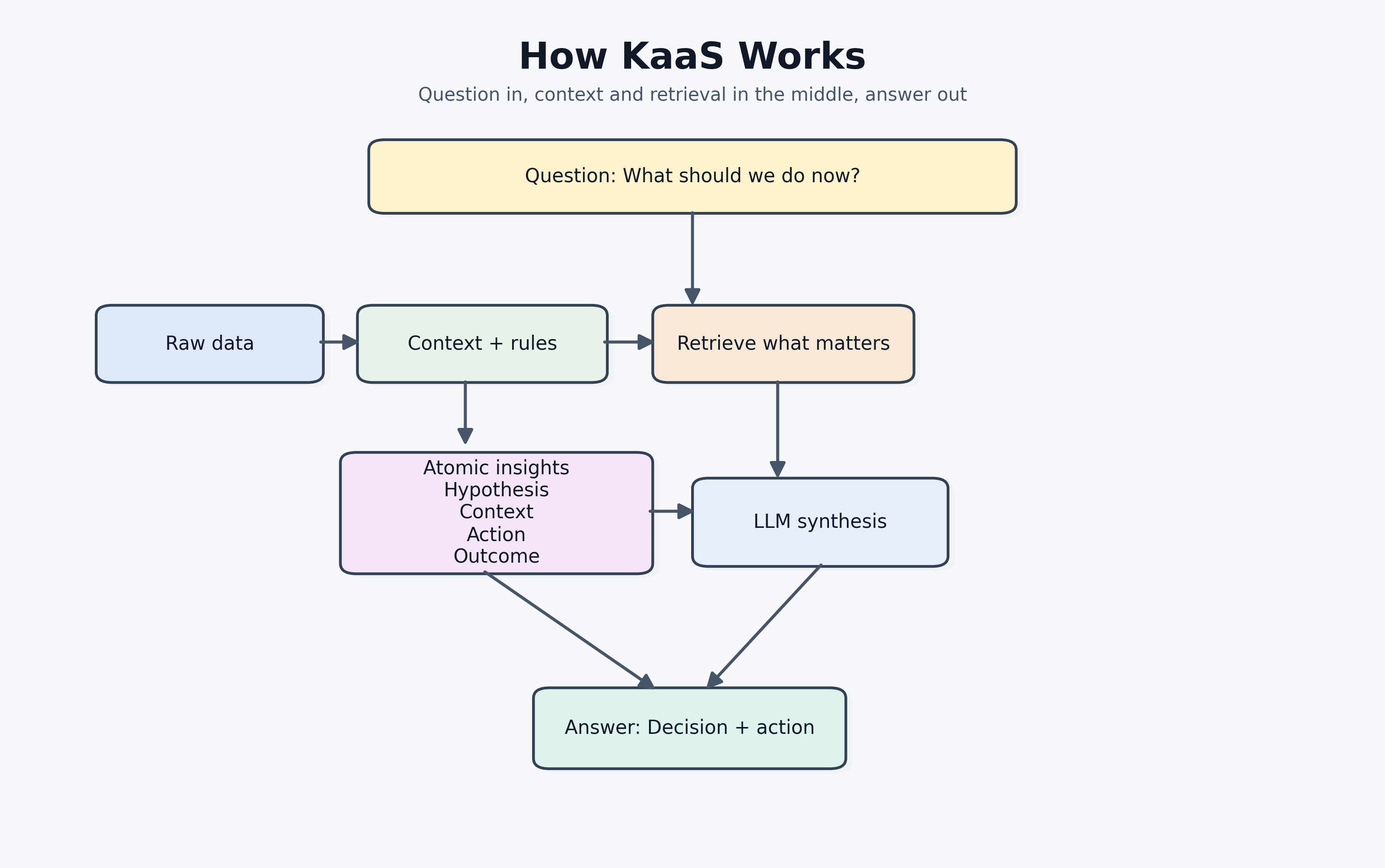
What replaces the SaaS stack
KaaS does not fully replace the SaaS stack so much as reorganize it around a different core. In knowledge-heavy products, most important layer is the one that decides what information is relevant, how it should be framed, and what should happen next.
In many cases, if the database is the commodity, the Retrieval Layer is where differentiation begins by applying the right precedent to the right moment.
Atomic insights
KaaS works best when knowledge is broken into atomic insights rather than buried in long documents or endless dashboards. Each insight should capture four things: hypothesis, context, action, and outcome.
Let us take a simple example of a marketing lead. SaaS database would store the details of the event. But, KaaS would store the logic behind it, what message and constraints produced that specific result. Once that is understood, it can autonomously create a new effective campaign. This is not about storing giga bytes of data, but to reduce this to sets of hypothesis and context. That helps the next marketing campaign to be more effective.
Retrieval systems vs databases
A database answers, “What is stored?” A retrieval system answers, “What matters now?” That distinction is the real architectural shift. KaaS is less about accumulating more information and more about surfacing the right pattern for the present moment.
That is why retrieval matters so much. A database holds raw material. A retrieval system turns that material into context. And context is what makes knowledge actionable.
Still, retrieval is not magic. It only works if the underlying data is trustworthy, well-structured, and representative enough to be useful. Good retrieval can surface precedent. It cannot fix bad inputs.
Where LLMs fit
LLMs sit on top of this architecture as a reasoning and synthesis layer. They help interpret, summarize, compare, and explain. But they are not the architecture itself.
That distinction matters. Models are powerful, but they are also fluid. The durable part is the knowledge system underneath: the retrieval layer, the structure of the insights, and the governance around what gets stored and reused.
The LLM is the interface to intelligence. The KaaS architecture is what makes that intelligence dependable.
Why this matters
This is what makes KaaS more than a new label for software. SaaS sold tools. KaaS sells better judgment.
That is a bigger promise, but also a harder one. Not every product needs this architecture, and not every decision can be reduced to retrieved precedent. Some knowledge is tacit. Some context is political. Some judgment only exists in the room.
But for products built around compounding knowledge, the shift is real. The system becomes less like software you operate and more like a memory layer you rely on. Over time, that may matter more than another prettier interface or another smarter dashboard.
Next in the series: Operating model of KaaS companies.